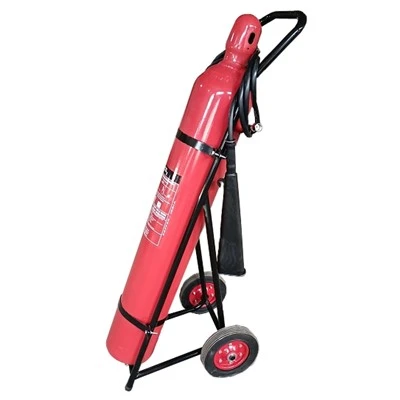
With the continuous improvement of fire safety requirements, stainless steel fire extinguishers have gradually become the mainstream of the market due to their advantages such as corrosion resistance, high strength and long life. The optimization of its forming process directly affects the performance and reliability of the product. This article will explore the main forming processes of stainless steel fire extinguishers in depth to help industry practitioners better understand its manufacturing process.
The forming of stainless steel fire extinguishers usually adopts processes such as stamping, welding and spinning. The stamping process is a key step in the initial forming. The stainless steel sheet is pressed by the mold to form basic components such as the cylinder and end cover. This process requires high-precision molds and stable pressure control to ensure the accuracy of the component dimensions and avoid deviations during subsequent welding or assembly.
The welding process is crucial in the manufacture of stainless steel fire extinguishers. The connection between the cylinder and the end cover usually adopts argon arc welding or laser welding. These two welding methods can effectively reduce the heat-affected zone and avoid embrittlement or deformation of stainless steel due to high temperature. After welding is completed, non-destructive testing, such as X-ray flaw detection or ultrasonic testing, is also required to ensure that the weld is defect-free and meets the safety requirements under high-pressure environments.
The spinning process is an advanced forming technology that has been widely used in recent years. The stainless steel cylinder is pressed by high-speed rotating molds to gradually form a uniform wall thickness and a smooth inner surface. Spinning can not only improve the strength of the cylinder, but also reduce material waste and improve production efficiency. Compared with the traditional stamping and welding process, the fire extinguisher formed by spinning is lighter and has stronger pressure resistance.
Surface treatment is also an important part of the forming of stainless steel fire extinguishers. Common treatment methods include polishing and passivation to enhance its corrosion resistance and aesthetics. Polishing can remove tiny scratches on the surface and improve anti-fouling ability; passivation forms a protective film on the surface through chemical reactions to extend the service life.
With the advancement of materials science and manufacturing technology, the forming process of stainless steel fire extinguishers is moving towards a more efficient and environmentally friendly direction. In the future, the introduction of intelligent production lines will further optimize the process flow, improve product quality and market competitiveness. Understanding these process details will help buyers and manufacturers better choose products that meet their needs and promote the sustainable development of the fire safety industry.